
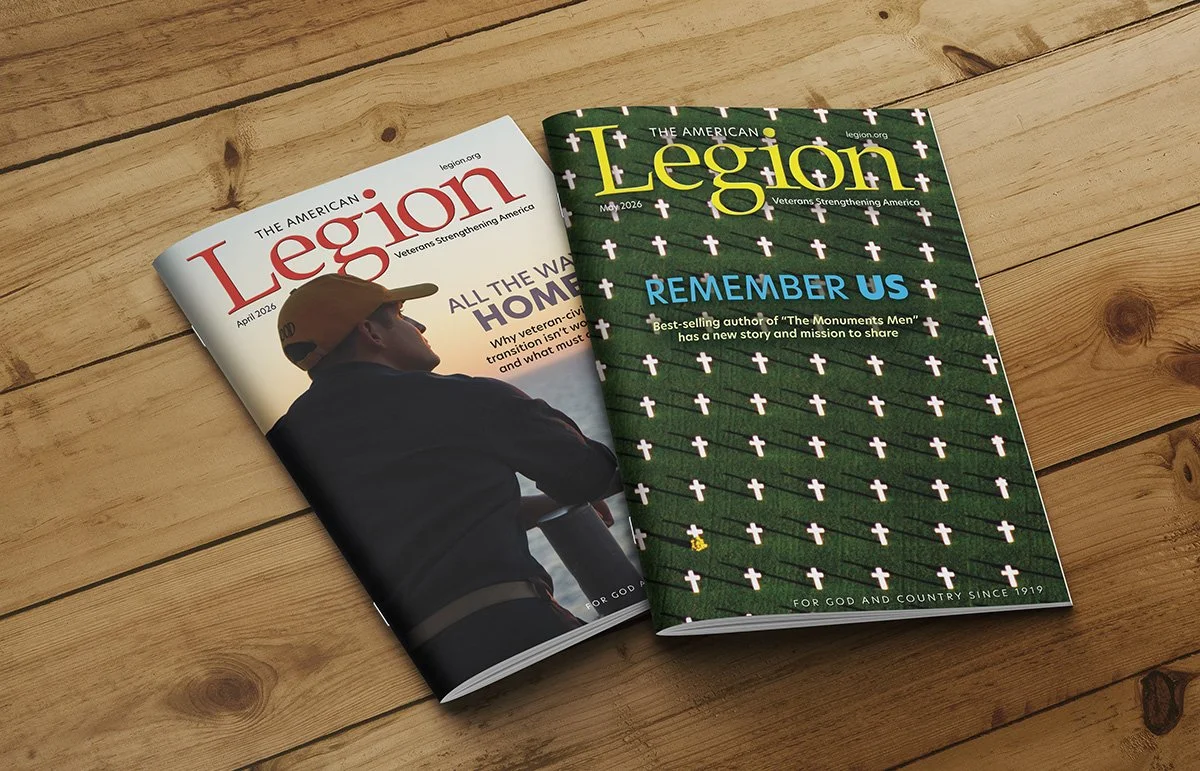
Republished with permission from the Bo Sacks Heard on the Web newsletter
By Ronn Levine
For the award-winning American Legion Magazine, a more compact size and additional pages will give its 1.6 million audience of veterans even more reasons to grab hold.
If you were running a publication that had just been named the best-read magazine among men in the United States and third for all audiences—according to a new survey by MRI-Simmons Spring Doublebase 2026 USA—the tendency might be to rest on your laurels.
But for Henry Howard, director of media and communications at the 107-year-old American Legion, and the rest of the staff at the 1.6 million circulation The American Legion Magazine, that’s simply not an option.
Those members depend on the magazine for high-interest topics related to the military, VA benefits, legislative advocacy, The American Legion's youth programs and more. Thus, accolades become more like a call to action.
“We wanted to innovate the print magazine at a time when people's reading habits are changing,” said Howard. “So we came up with a concept to make it more compact but add pages. And in doing so, it will force us to write even more tightly. Not only does this new format allow us to keep all the standing features our readers love, but we can add features like national security.”
Incremental changes had been made to the award-winning magazine in recent years to tell more stories in “digestible chunks,” but it “became time to take a step back and ask how we could make it better,” Howard said.
His team unveiled a new prototype at the organization’s national convention in August. Members received a copy, and the feedback was unanimous. “They loved it,” Howard said. “They talked about how it was easier to flip through. And they love the new features we added. We shared some of those testimonials with Jim and team to pitch clients.”
That’s Jim Elliott, CEO and owner of James G. Elliott Co., who has handled advertising for The American Legion Magazine for many years. “People say magazine advertising is going away,” he said. “But we're up from last year. And the numbers aren't small. We get results because people trust this organization.”
As for the more compact size, Elliott said that “it opens the door to conversations with either new people or people who we haven't chatted with in a while. Doing the same thing over and over gets tiring. Henry’s team designed this really well, so that we had enough time to talk with clients and prospects. We still have another couple of months”—the new format launches in February—”so we still have more work to do. But it’s a great move.”

“People say magazine advertising is going away, but we're up from last year.”
Jim Elliott, CEO The Elliott Company, Inc.
If you’ve only heard of the American Legion in passing, the organization received a charter from Congress in 1919, with a mission to help the veterans who were overseas during World War I assimilate back into society—and much of that is the same today. That can mean helping with VA benefit claims, attending job fairs, rehabilitation—they have over 3000 accredited service officers to help with that—suicide prevention, and much more.
It was the American Legion that “stuck its neck out, made the case and essentially wrote the GI Bill and fought for its passage,” Howard said. “And it has changed the lives of easily millions of service members, their families, and the communities in which they live.
Helping veterans remains at the center of everything they do. Howard said big strides have been made to add more women to the magazine’s pages and audience.
“We pursue legislation on Capitol Hill that will benefit women,” he said. “We highlight issues that are important to them, like healthcare and MST [military sexual trauma]. September is National Service Dog Month, so we did a callout, asking veterans to share their stories about their service dogs. A woman veteran in Utah recently got hers and wrote a compelling piece for the website. We ended up with more than 30 stories, many from women.”
The online version of the magazine will also be revamped. “We're moving to a more vibrant, modern digital publication, where we'll be able to better incorporate all the multimedia within the story itself—photos, videos, podcast clips, that kind of thing,” Howard said. “That's just a piece of our legion.org website. We produce probably 20-30 stories a week for the website.”
The new print magazine will also feature a monthly spread called GoCode that will include QR codes for their twice-a-month podcast, videos, and other multimedia and features. “It will literally be a call to action,” Howard said. “We're trying to tie our digital and print worlds together.”
That podcast, titled Tango Alpha Lima, won three national awards in 2021 for a series focusing on the 20th anniversary of 9/11—20 stories in 20 days. “We had a man who was an air traffic controller for Flight 93 who had never talked publicly about that day before,” said Howard. “We had Jessica Lynch, the former POW. We had a ferry boat captain whose job was to literally get as many people off the island as he could.
“The series really helped put us on the map. A year ago we had Ken Burns on when he was releasing his documentary series American Revolution. The podcast world is challenging, but we're able to broaden our storytelling and reach a new audience through them.”
There were also podcast episodes featuring American Legion’s Be the One program, designed to reduce the number of veterans lost to suicide each year. “In my 14 years at the American Legion, I have never seen anything take off so well at the grassroots level than Be the One,” Howard said. “We had multiple stories recently about how American Legion posts are conducting events to raise awareness for it.”
Awareness of all the organization’s programs should only increase with the magazine’s new appearance. “As we looked at the idea of changing the format, we thought about the modern reader and the new ways we can present our content,” Howard said. “It’s very exciting.”
